Fighting with Gods
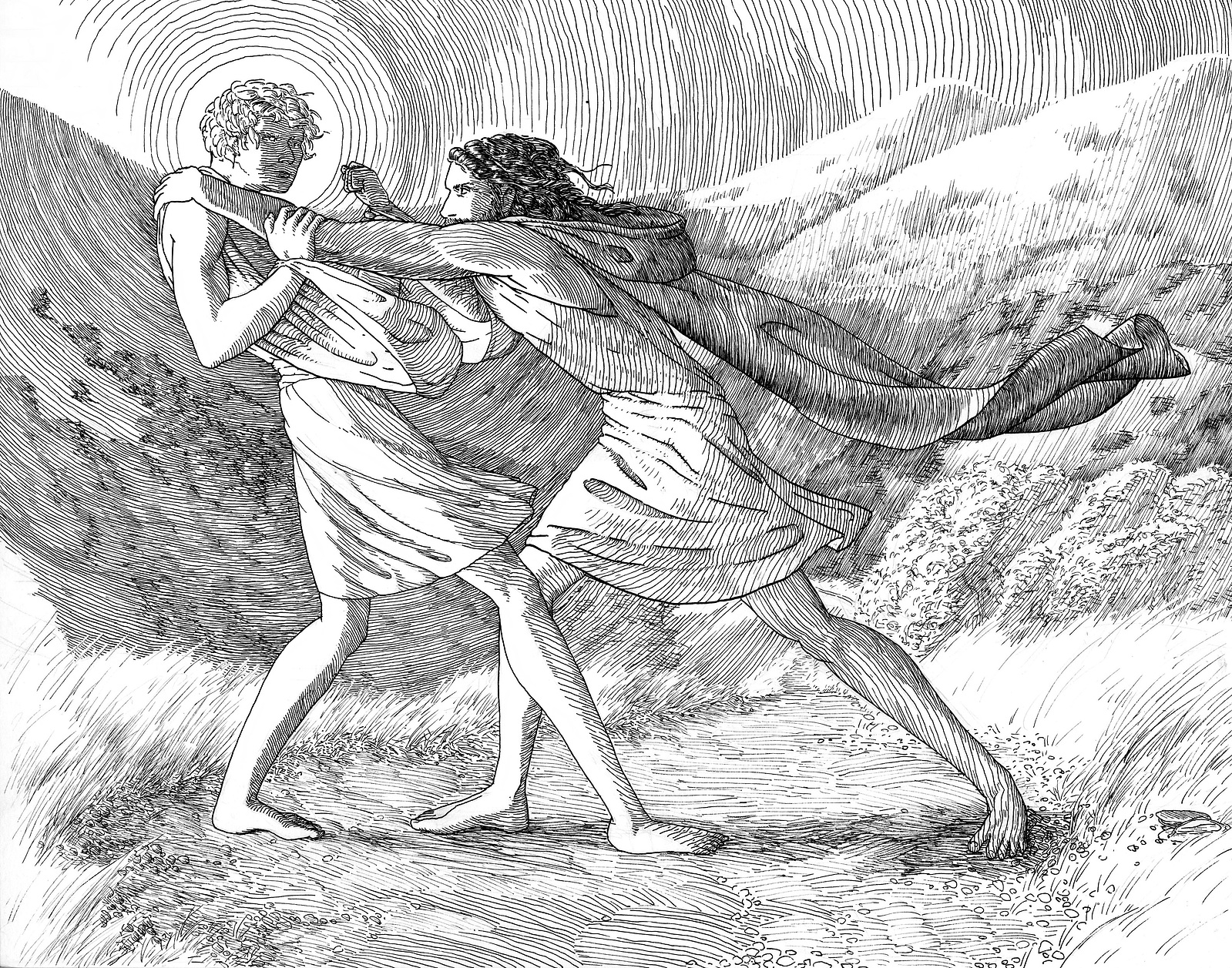
We approach ancient religious texts, often, to understand what it meant for individuals to worship deities–for the authority that gods have, for the wisdom of their rules, or for models of devotion among mortals–but what should we make of moments when they fight instead? In Genesis, at precisely the moment that a figure like Jacob is elevated to the stature of “Israel,” he has just wrestled, physically, with God. And in the Iliad, when Diomedes is at the height of his battle-powers with favor from Athena, he is also throwing his spear directly at Aphrodite. Erich Auerbach famously distinguishes these texts by arguing that the Bible keeps the thoughts of God and his followers in the “background” (preserving an interpretive mystery for scripture-readers), whereas Homer puts everything from memories to physical sensations in the “foreground” (he “conceals nothing,” giving the epic-listener a sense of constant immediacy). But this doesn’t account for a bigger structural difference between the two works, since the Bible needs to cover generations and centuries of life whereas the Iliad covers only a few weeks of action. When, instead, we consider two scenes of roughly equal description and duration–and, moreover, two scenes relaying the same type of action–we gain more from the comparison. Looking at Genesis 32 and Iliad 5, we see a moment when the otherwise spiritual relationships of the Bible become physical, and a moment when the otherwise physical altercations of the Trojan War become moral. At this point of convergence–where the physical meets the metaphysical and mortals entangle with gods–we understand a shared idea about heroism from these two traditions. Jacob and Diomedes are paragons for their respective cultures because of their dual gifts: they are able to contend with gods physically, raising their own legacies as superhuman fighters, and they are also able to contend with them on another plane, raising their legacies as awe-inspiring leaders.
In the Bible, God usually punishes people for defying him, but Jacob gets the opposite: he is rewarded for wrestling with God, which could imply that this wrestling match is a mostly metaphorical test of Jacob’s faith. Faith involves both believing that God exists and believing that one should do what God says. Jacob’s two requests of God ask for reassurance in these two facets of faith. One piece of evidence is that Jacob says “I will not let thee go, except thou bless me,” (Gen 32:26) which implies that he knows that his opponent is someone who has the power of blessing people, and is probably a divine being. He is confident that he can hold God down so he doesn’t release him unconditionally. Jacob seemingly knows that this man whom he is wrestling with is someone who can bless him, but he does not say, “Oh, you are too high in status for me to fight.” Instead, he says he will only let him go if blessed. This is not a typical response to being faced with a divine being. However, God accepts being treated impertinently, which would make sense if they were not actually competing in a serious manner. We are led to wonder what the stakes of the fight really are, then, and we turn to the terms of victory: “he saw that he prevailed not against him,” and “prevailing not” can mean “lost” or “did not win” (Gen 32:25, emphasis added). Prevail means to win, but not winning is different from losing. If one does not win, one could have a tie or still be fighting. God could presumably squish Jacob, but he doesn’t. The reader realizes, at this juncture, that physical prevalence matters less than some other, undefined, spiritual contest involving defiance and blessing. Faith in the sense of acknowledging divine power is in play, but Jacob’s faith-based trust in a future contract with God adds a more significant metaphorical layer.
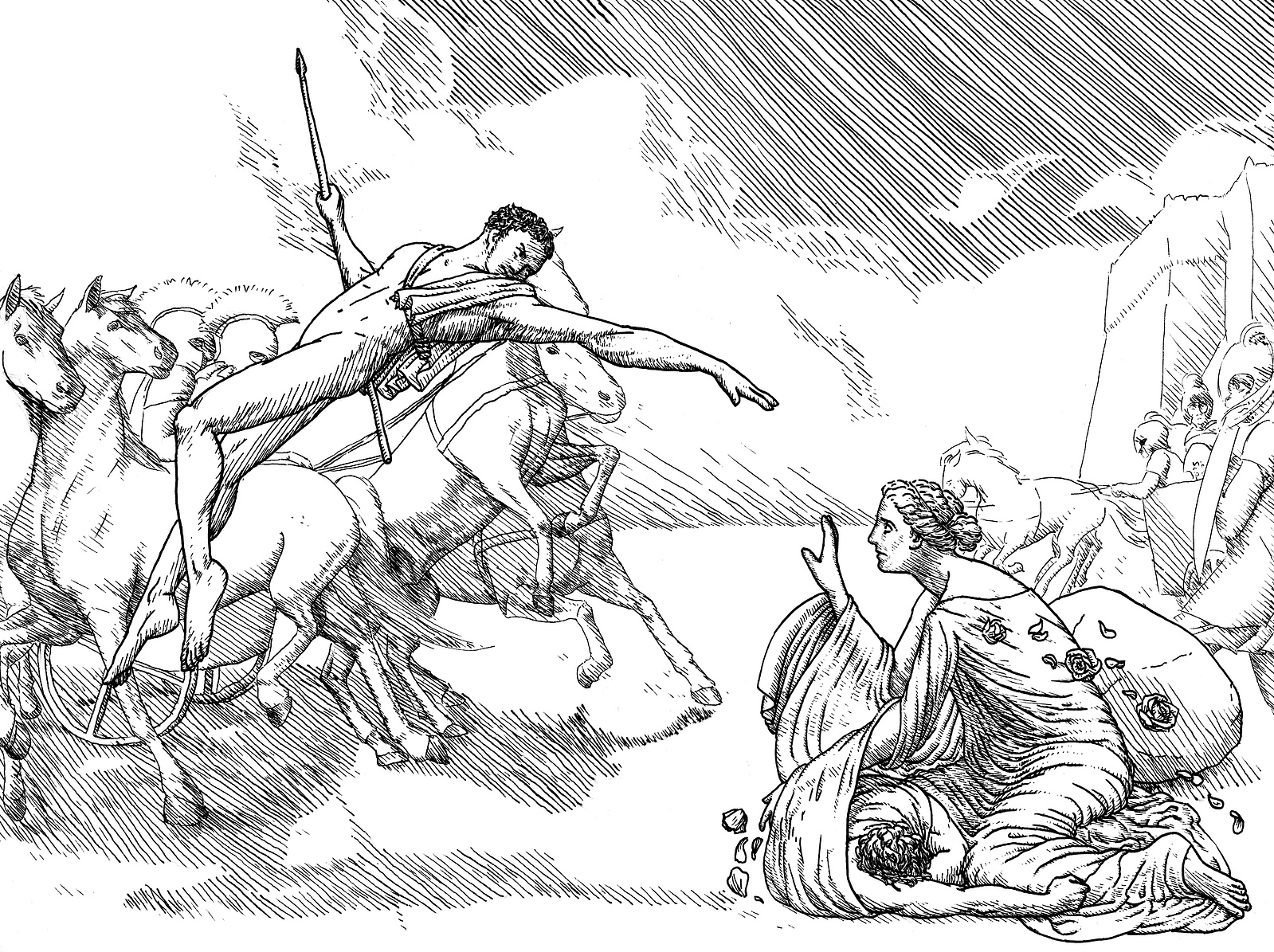
Conversely, in the Iliad, Aphrodite is first presented as blessed and above everything, but is reduced quickly to her physical being. She is quickly proven to be vulnerable when Diomedes cuts her through her previously invulnerable robes. She is described like a force of nature, which makes her seem unstoppable, but then those natural qualities make her more like humans when Diomedes hits her with a spear. When Aphrodite first intervenes to save her son Aeneas, Homer describes her divinity like this:
Round her beloved son her glistening arms went streaming,
flinging her shining robe before him, only a fold
but it blocked the weapons hurtling toward his body. (Iliad 5.351-3, emphasis added)
It is established that one fold of Aphrodite’s robe blocks ordinary weapons from hitting Aeneas. Specifically, her supernatural garments draw from natural forces, when her arms go “streaming.” The metaphor compares her to the natural force of water, which sets her up as formidable and almost un-fightable. But when Diomedes pierces through this supposedly invulnerable protection, the rules that Homer has set up fall immediately to pieces.
He gouged her just where the wristbone joins the palm
and immortal blood came flowing quickly from the goddess,
… (Iliad 5. 380-4, emphasis added)
The metaphor of a river turns into her surprisingly human blood. Now her natural qualities make her more like a human. Homer takes pains to tell how gods’ blood is different and more blessed than mortals’. However, this difference does not seem to matter. Although the gods technically have immortal ichor, they still bleed in exactly the same way as humans. This shows how gods and mortals are surprisingly similar, once we see them share a physical plane.
The metaphor of a river turns into her surprisingly human blood. Now her natural qualities make her more like a human. Homer takes pains to tell how gods’ blood is different and more blessed than mortals’. However, this difference does not seem to matter. Although the gods technically have immortal ichor, they still bleed in exactly the same way as humans. This shows how gods and mortals are surprisingly similar, once we see them share a physical plane.
Up until this point, the two texts seem distinct in the way that Eric Auerbach and others have delineated: the Bible offers us a mysterious, backgrounded, metaphysical monotheism, whereas the Iliad gives us concrete, foregrounded, physical gods. However, once we start to fixate on the specific graphic descriptions of fighting in the Iliad, we see, surprisingly, parallel details in Genesis. The fight between God and Jacob isn’t just allegory.
Ge32:24 And Jacob was left alone; and there wrestled a man with him until the breaking of the day.
Ge32:25 And when he saw that he prevailed not against him, he touched the hollow of his thigh; and the hollow of Jacob's thigh was out of joint, as he wrestled with him.
It’s tempting to think that Jacob’s fight with God is wholly spiritually based on his strange entrance and interaction with Jacob. However, the text literally says that Jacob’s hip socket was out of joint. Dislocating one’s hip cannot be done whilst thrashing around in a spiritual fight. Jacob had to physically fight God instead of submitting to him in order to prevail. If he just ran away then he would have failed. And in the same way that the fight has spiritual and physical elements alike, the result is also doubled. At first, the importance of the scene for Jacob and his followers expands to the abstract notion of national identity, when God renames him “Israel” and describes him as having “striven with God and with humans” (Gen 32:28). But by the end of the passage, a different moral emerges: “Therefore to this day the Israelites do not eat the thigh muscle that is on the hip socket, because he struck Jacob on the hip socket at the thigh muscle” (Gen 32:32). The Jacob story is revealed to be the reason for a minor dietary restriction. What may, at one point, be a national origin story is also brought down to a banal domestic practice.
If our reading of Homer allows us to see the simple physical ending of Genesis, the reverse journey into the Iliad is more complicated. What we are looking for is an equivalent moment for Jacob’s blessing, or the new name he receives, in the story of Diomedes, but this takes multiple forms over the course of the entire Aphrodite scene. Fundamentally, Homer positions Diomedes as an archetype of masculinity against Aphrodite’s femininity, in three ways: his leadership over other men, his physical fighting prowess, and the fear he strikes into enemies–even divine.
At the outset, we see Diomedes in a superior role over other warriors. Aphrodite’s power lies in being alluring and making people fall in love with each other. Aphrodite is powerful in a very feminine way. However, she is defeated by strength of arms and shattering war cries. Aphrodite started the Trojan War by making Helen run away with Paris, so Diomedes fighting Aphrodite is like he’s fighting the whole reason for the war.
She began to bear her dear son from the fighting . . .
but Capaneus' son did not forget the commands
the lord of the war cry put him under. Sthenelus
checked his own racers clear of the crash of battle.
lashed them tight to his chariot-rails with reins
then dashed for Aeneas' glossy full-maned team
and drove them out of the Trojan lines and into his.
In this quote, Diomedes shows his skill at leading people into battle. Sthenelus executes this complicated horse-stealing maneuver in the midst of battle because Diomedes told him to. It is hard to do anything while on the field of battle, so to steal one’s opponent’s horses is even more difficult.
But once he caught her, stalking her through the onslaught,
gallant Tydeus' offspring rushed her, lunging out,
thrusting his sharp spear at her soft, limp wrist
and the brazen point went slashing through her flesh,
tearing straight 'through the fresh immortal robes
the Graces themselves had made her with their labor.
In this quote, Diomedes shows his skill at fighting. He slashes Aphrodite in the wrist, which is even more impressive because the spear also tears through previously invulnerable robes. Diomedes is described as “stalking” Aphrodite, which makes him sound dangerous and menacing.
But Diomedes shouted after her, shattering war cries:
"Daughter of Zeus, give up the war, your lust for carnage!
So, it's not enough that you lure defenseless women
to their ruin? Haunting the fighting, are you?
Now I think you'll cringe at the hint of war
if you get wind of battle far away."
In this quote, Diomedes shows that he is good at causing fear. He causes Aphrodite to run away and then yells at her. His triumph is like Jacob’s because he did a very praiseworthy deed in the eyes of his society and also fought successfully against a god.
Here, a critic might point out that, in at least one respect, I have fallen into the same trap that I accused Auerbach of falling into: I have based this argument around a single scene from each text. But once we learn to see the physical in Genesis and the moral in the Iliad, examples proliferate beyond Jacob and Diomedes. In the early books of the Bible, long stretches of scripture have little to do with the philosophy of faith: in Leviticus, for example, we are faced with a litany of detailed, physical, ritual rules. It is forbidden to eat animal fat because one is meant to sacrifice the fat; (Leviticus 7:23–25) one is permitted to eat locusts, beetles, and grasshoppers, but no other insect; (11:22–23) and there are many types of sacrifices of food, many of which are intended to be eaten by the priests. Conversely, in the Iliad, Diomedes is not even the only human hero to rebuke Aphrodite: in Book Three, Helen says “Maddening one, my Goddess, oh what now? / Lusting to lure me to my ruin yet again? (460-1)” These texts, whose beliefs we sometimes try to reduce to simple cultural mores or institutional rules, in fact seem to enjoy changing their modes of teaching or storytelling, luring their truest readers into ambiguity and complexity. Rather than try to simplify them (or, like Auerbach, categorize them), we should understand how they shift from moment to moment, and be prepared to wrestle.
Notes on the project
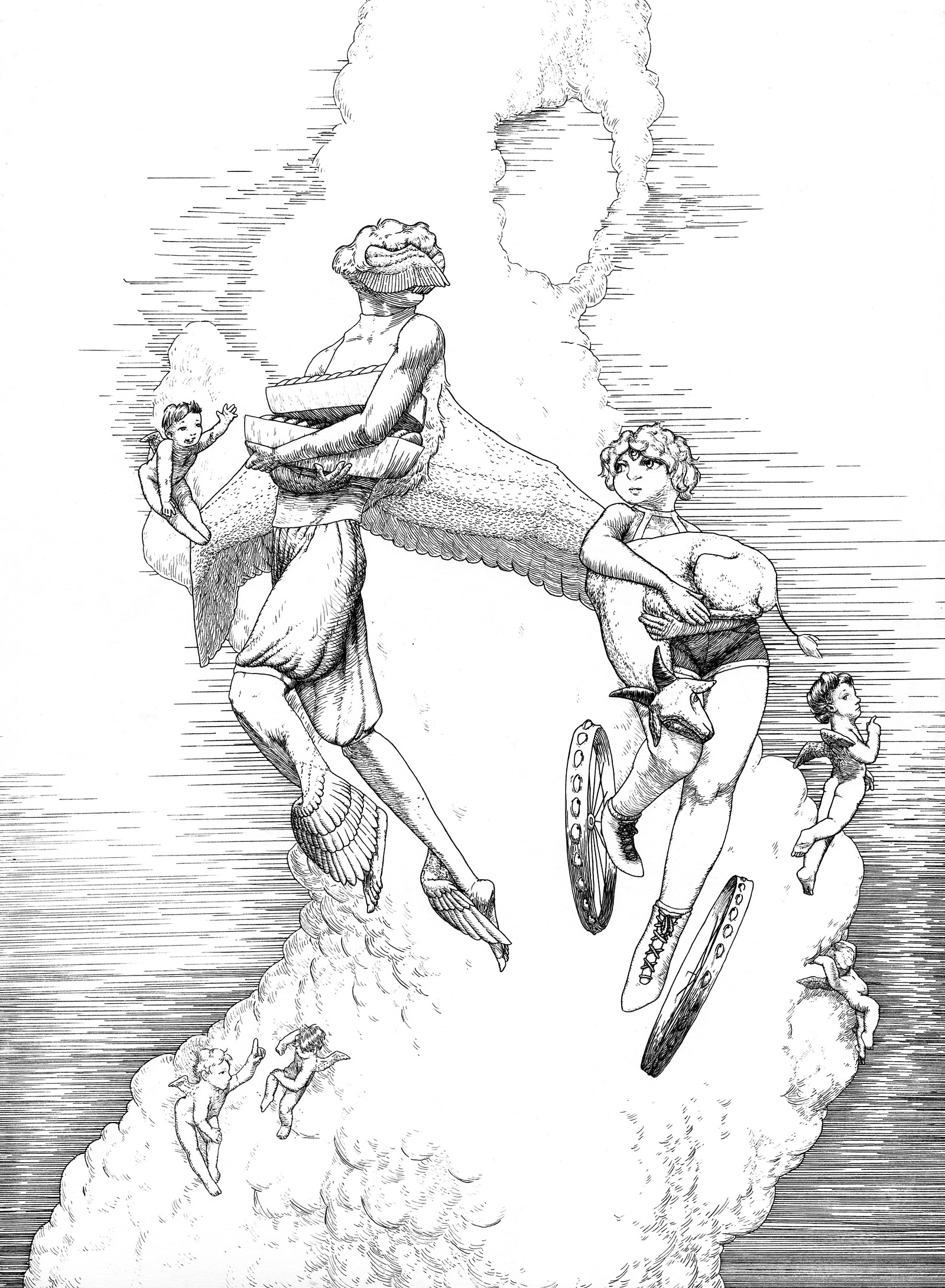
This was a summer project in 2024, where I had just read the Iliad and KJV back-to-back, and was introduced to Mimesis by Erich Auerbach . I was also inspired by Dore and chose to illustrate and compare two sections that both had very different conceptions of "Man fighting the Divine".
It was more work than I anticipated, but I enjoyed the close reading and the imagery. Many thanks to Miles Osgood for helping me with all of this.