Faith and Faithlessness in the Inferno
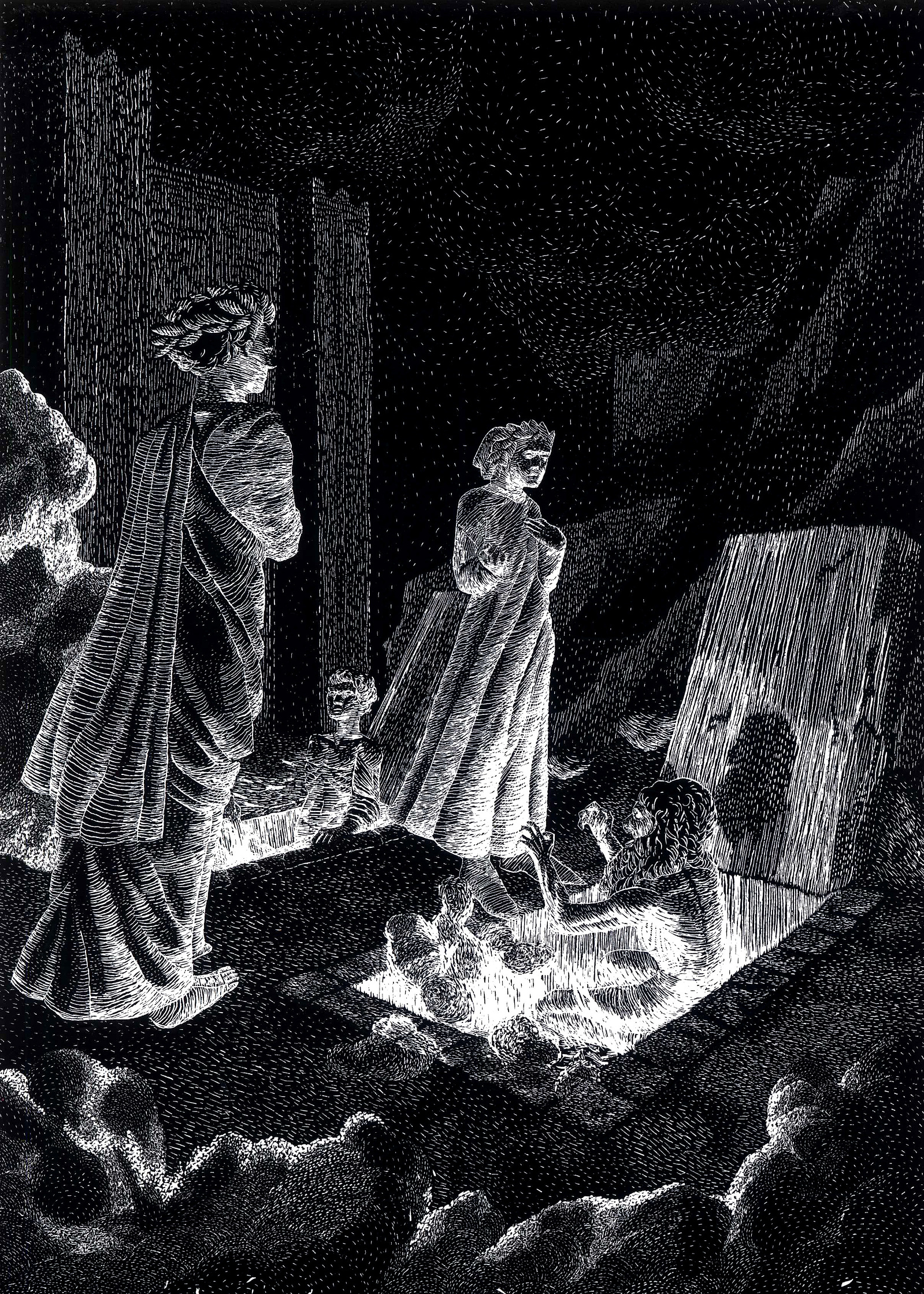
The Divine Comedy is an epic poem that depicts Dante, the author and protagonist, being guided through all realms of the afterlife in order to become a better person. I like Dante because he brings together paganism, Christianity, and contemporary politics delightfully. I chose to illustrate Canto 10 because I feel that the earlier cantos, which depict places similar to those on earth, are easier to depict with the proper horrors of Hell; the more grandiose descriptions of the later cantos are at risk of appearing silly in this fantasy-saturated age.
The canto that I chose to illustrate depicts the epicureans. Dante, the author, uses “epicureans” to mean people who didn’t believe in an immortal soul. In this scene, Dante encounters several non-mythic Florentines. When Dante meets mythic figures, out of Greek, Roman or Biblical tales, we already know their history before he meets them. However, when he encounters his own contemporaries, we may not know much about them and therefore, Dante's depiction of them tells us more about their actual historical significance. It also gives us a more specific understanding of this particular time period, as opposed to Dante’s second-hand knowledge of mythic times.
I illustrated the scene from the Inferno where Dante talks to Cavalcante in the style of Doré, an 1800’s French artist who made many etchings of famous books including the Inferno. First, the character Dante is shown to be actually competent. Many Dante fans prefer to focus on Dante constantly fainting and being endearingly pathetic. However, in this moment, he delivers several witty retorts, showing his verbal expertise. Second, I thought the scene would look good in a drawing, as the fire would give a high contrast lighting effect to the characters. Third, it is a dramatic scene and yet Doré had not drawn it already. I wanted to draw a scene in the style of Doré, but not one he had already illustrated because I wanted to avoid either copying him orsetting myself up in comparison to his expertise.
I used scratchboard to draw this scene because it is an easy way to get bright white lines on a dark black surface. Doré made etchings, but I’m not as familiar with that technique and I didn’t want to be exploring a new medium while attempting a serious work within it. I drew the scene dark because it is located in Hell and it would stylistically match Doré’s drawings of adjacent scenes. Starting with a dark background is technically simpler, and would also draw one’s attention to the sepulchers filled with flame.
I drew Dante standing straight up so he looks confident. He is large, near the center, and the scenery moves one’s eye towards him. This makes him compositionally the most important character. In this scene, there are several characters: Dante himself; Virgil, an ancient Roman poet and Dante's guide in the underworld; Farinata, a Florentine politician; and Cavalcante, a Florentine philosopher, both condemned to Hell because of their materialism and lack of faith. Virgil looks at Dante, framing the picture such that the viewer doesn’t look off the page. Farinata is looking straight forward because he is unaware of what is around him, just as he was in life. I drew Cavalcante in a kneeling pose of despair, hoping to make him contrast with the rigid Farinata and the confident Dante. I included many details from the story to make the drawing more legible by itself.
One of those contemporary characters is Cavalcante, the father of Dante's former friend, Guido. Dante and Guido were friends who shared a love of poetry in their youth, but fell out over the nature of love. Guido thought love was inherently tragic, whereas Dante thought love could lead people to God. Dante's outlook is obviously appropriate for someone writing an epic poem about his love for Beatrice leading him through the underworld to God. The Cavalcantis were materialists; they thought the material world was all that existed. This is proven wrong as Dante, the protagonist, spends the whole poem in non material places.
I tried to make the epicureans’ lack of spiritual awareness obvious by drawing Cavalcante reacting only to Dante instead of to his sepulcher’s eternal fire. I also drew attention to Cavalcante by surrounding him with bright flames, which draws the viewer's eye. However, he is also turned away and looking up at Dante, which makes Dante the central character in the scene.
The obliviousness of the materialists is shown in Dante’s interaction with Cavalcante. Cavalcante asks Dante where his son Guido is, implying that he feels his son was Dante's intellectual equal and should be traveling with Dante on his tour through Hell. Dante responds, “Da me stesso non vegno: / colui ch’attende là, per qui mi mena / forse cui Guido vostro ebbe a disdegno” [I answered: “My own powers have not brought me; / he [Virgil] who awaits me there, leads me through here / perhaps to one your Guido did disdain.”] Cavalcante leaps to the conclusion that Guido has already died, because Dante uses the word “ebbe” or “did”, and does not wait for Dante’s clarification. Cavalcante fixates on a single word of Dante’s, makes an entirely non-obvious assumption, and then falls back into his sepulcher in despair instead of waiting for the full response. Farinata, on the other hand, is entirely focused on politics, to the exclusion of all that surrounds him, even in Hell.
Dante, the author, thus shows how foolish he thinks the materialists were for not believing in anything greater than the immanent world. I find this scene intellectually compelling because of its exploration of faith and its absence. While Dante clearly has figured out his view of this issue, it is a controversy that people have struggled with for centuries, and continues to be relevant today.
Notes on the project
This was a summer project in 2025, where I was able to access primary sources at the Cantor museum and Green Library and Stanford and sketch original art by Dore and Rodin.
I tried to a new rendering technique and re-read the Inferno. Many thanks to Prof. Berchi for being my guide and helping me through this remarkable work.